KCC Week 7 Recap: General Assembly 2026

Passing the Halfway Mark
This Friday we completed day 31 of the 60-day session. We have now passed the 7th week of the General Assembly. Follow the bill links above for our full summaries of bills, including amendments and other changes. The last day for lawmakers to file new bills is in the Senate is on Monday, March 2nd. The last day for lawmakers to file new bills in the House is March 4th. Please call the legislative message line at 1-800-372-7181 (Monday-Friday 7AM-6PM) to express your views on these bills. You may also email your legislators if the phone lines are closed.
Thank you for your fast action! Keep it up!
On Tuesday of this past week, we sent out an urgent action alert to oppose Senate bill 178, and we appreciated every one of your fast action to stop this bill. Due in part to your calls, the meeting on this bill was cancelled. HOWEVER we expect it to come back soon, so please continue to call and email your opposition to this bill.
This bill eviscerates the “precautionary principle”— a fundamental legal principle that requires those proposing a new activity to demonstrate its safety, rather than the public proving it's harmful. This bill puts the risk of environmental harm on the public, rather than the entities creating that harm. This bill is putting profit over safety, and putting the environment and public health in substantial risk of harm. So please continue to oppose this bill!!! Full details on our Senate bill list.
New Bills of Note This Week
New to our “strong oppose” list is House Bill 659, impacting administrative hearings. This bill Increases the burden of persuasion in all administrative hearings (and specifically amending KRS 151.184 and 224.10-440 related to water protections and permitting) from a preponderance of evidence to clear and convincing evidence. The burden of persuasion falls on the party requesting the agency take action or grant a benefit, or the agency to show the propriety of a penalty imposed or the removal of a benefit previously granted. Requires costs and reasonable attorney's fees to be awarded to parties that prevail against agencies in any action, including specifically the Energy and Environment Cabinet.
New to our “support” list this week are a pair of bills, Senate Bill 210 and House Bill 677. These bills establish a legal and regulatory framework for the development and approval of underground carbon capture and sequestration (CCS) facilities. While carbon capture and sequestration is certainly not an adequate tool to address climate change, the Kentucky Conservation Committee and our allies at Ky. Resources Council worked alongside the Energy and Environment Cabinet and oil and gas experts for several years to address this complicated issue and these bills are the result of that work. We invite you to read the detailed description of these bills in this week’s House and Senate bill lists.
Continuing Actions
As we now are past the halfway point in the session, bills can move and change rapidly. It is more important than ever to watch for KCC alerts and check our social media on Facebook, X, and Instragram in addition to our weekly blog. We will be posting more on the state budget as it evolves, and we also ask that you continue to review our bill lists above and act on “strong oppose” and “strong support” bills.
Money and Power
Louisville Public Media reported this week that two of Kentucky’s largest electric utility providers made their way into the list of the top 10 lobbying spenders in January — Louisville Gas & Electric and Kentucky Utilities and the Kentucky Association of Electric Cooperatives, a collection of two dozen nonprofit consumer-owned utilities. Both reported lobbying on House Bill 398, (KCC Oppose) which revisits two laws passed in recent years that make it harder for utility companies to retire coal-fired power plants. The representative for Eastern Kentucky Power Cooperative testified testified in committee that HB 398 would allow utilities recover costs from consumers for the decommissioning of a plant before its retirement is authorized. The bill cleared the House by a wide margin and is now in the Senate. But don’t forget—the real power is in your calls, emails, and visits with your lawmakers on the bills you care about. This past week KCC member Gail Lincoln and citizens from “We are Mason County” joined us in Frankfort to discuss projects impacting them including pipelines and data centers (photo below). We’re here to help when you want to make your voice heard!
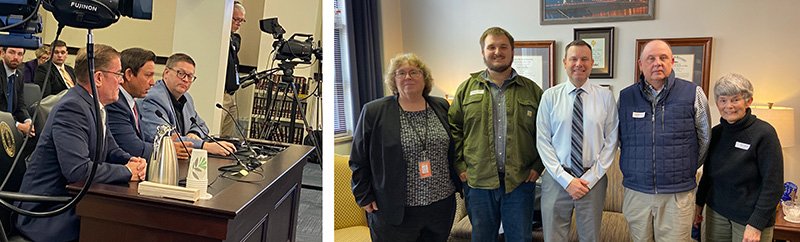
Left Photo: Florida’s Governor DeSantis lobbies for changing the U.S. Constitution. Right Photo: KCC’s Director, KCC member Gail Lincoln, and citizens from “We Are Mason County” discuss data centers and pipelines with Senator West.
Protecting the Constitution
On Wednesday of this week, Florida’s Governor Ron DeSantis was in town to testify on House Concurrent Resolution 45, which would call on Congress to create a balanced budget amendment for states to ratify. While there certainly is strong interest for the United States to get its rising debt under control, we assume there is a larger agenda at play here. For many sessions now, multiple resolutions have been filed in the Kentucky Legislature that include provisions to call for a “Convention of States” to address various issues under Article V of the U.S. Constitution.
Article V provides a mechanism for states to bypass Congress and initiate amendments. If 34 state legislatures (two-thirds) apply for a Convention of States, Congress must call this convention. Proposed amendments require ratification by 38 states (three-fourths) to become law. This method to amend the U.S. Constitution has never been used in U.S. history, however it is reported that 28 states have already passed legislation to allow for the calling of such a Convention. There are no established rules for how such a convention would operate, creating concerns that it could become a "runaway convention" that proposes changes beyond the original scope. Lobby groups such as Convention of States Action have been lobbying state legislatures for a Convention, while progressive groups such as Common Cause have been petitioning against such efforts. KCC regularly opposes “Article V” resolutions such as these. There are four such resolutions filed in the Kentucky General Assembly this session so far—HCR45 (J. Petrie), HJR51 (J. Decker), and SJR51 (P. Wheeler) which call for fiscal restraint, as well as SJR17 (M. Wise) which calls for term limits for members of Congress.
We want to particularly acknowledge the comments of Rep. Donworth during the hearing this week on HCR45 in the House Standing Committee on Elections, Constitutional Amendments & Intergovernmental Affairs and House State Government joint committee meeting this week— where she pushed back on the premise that these resolutions would not lead to unintended threats to the Constitution: “I am not willing to put our entire country at risk over this, and I think the idea of having a balanced budget is wonderful, and I think we should all aspire to that,” she said. “However, that is Congress’ duty, and if they are not willing to do that right now, then we need to look at reforms there.”