
Strengthening Outdoor Recreation Advocacy
The Kentucky Conservation Committee is partnering with our friends at Explore Kentucky to build a statewide database of organizations, businesses, agencies and community partners working in conservation, outdoor recreation, advocacy and outdoor access. Our goal is to make it easier to find one another, build partnerships, pursue funding, support local communities, and strengthen Kentucky’s lands, waters and outdoor economy. Use this link to help us build a stronger statewide network.
Wild and Scenic Film Festival— August 28th
See our full list of films and links for the 2026 Festival here
KCC Wild and Scenic Auction is now Live (More items being accepted)
Join us in person at the Farish Theater, OR join us virtually from your home!. The Kentucky Conservation Committee is excited to be bringing our 10th Annual Wild & Scenic Film Festival to you. We want to offer you the opportunity to see nation's largest environmental film festival. [NOTE: Tickets must be ordered in advance at this link]. You can also find information about the festival on the national Wild and Scenic Festival website. Our thanks to sponsors Silicon Ranch, Republic Bank, Wild Birds Unlimited Lexington, Solar Energy Solutions, Oakford Multimedia, and Michler’s Florist.
Recent Data Center Actions
The Kentucky Conservation Committee continues to track the rapid growth of data centers in Kentucky. You can find helpful information and resources on our website.
Lexington-Fayette Urban County Council unanimously passed a temporary moratorium on new data center permits and development plans through October 31, 2026.
The London City Council passed a strict two-year moratorium on data centers within city limits, lasting until September 30, 2028, to study community and utility impacts.
Harrison County & Jessamine County: Local fiscal courts and nearby city councils (such as Nicholasville) have proposed or weighed similar emergency pauses and zoning reviews amid heavy public opposition.
Upcoming Data Center Workshops:
Saturday, Aug. 8, 1-3PM, Rowan County Public Library, 175 Beacon Hill Road, Morehead, KY. Sign up at tinyurl.com/K4EDMoreheadDC
Sunday, Aug. 16, time TBD, hosted by Kentuckians for Energy Democracy.
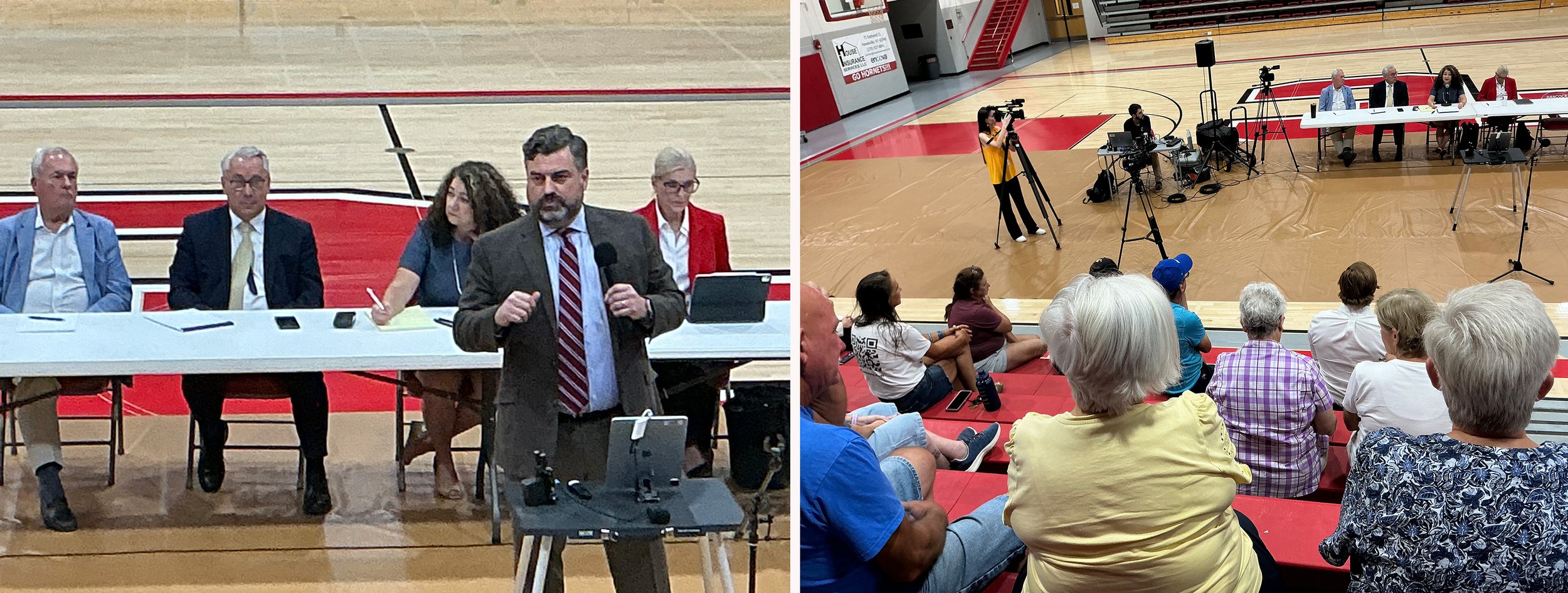
Public Service Commission public comment meeting on the TerraWulf project in Hawesvillle
Manufacturing vs. Data Centers— Who Pays the Price?
When Kentucky’s biggest data center project eyed a former steel mill in Eastern Kentucky, and one of the few remaining aluminum smelters in the United States was sold for conversion into a data center, it may have sounded like reuse and reinvestment. But for workers, manufacturers, and Kentucky families who are already navigating rising electric bills, the expansion of data centers raises a deeper question: who really benefits when these facilities move in, and who pays the price?
KCC attended the July 27 public meeting before the Public Service Commission on the proposed TeraWulf data center at the Hawesville aluminum site, which only sharpened that question. Many attendees raised questions about the new facility's impact on utility rates and the added noise of a data center operation. Several former Century Aluminum and Big Rivers utility employees stated how they were already struggling with their utility bills and raised concerns about any future expansion of the project beyond what was being presented to them. Several clearly stated: "nobody wants this here.”
The competition is already shaping Kentucky’s economic future. A new smelter that was supposed to come to Kentucky ultimately went to Oklahoma because Oklahoma had the clean energy infrastructure to support it, while Kentucky did not. In a survey conducted by Industrious Labs in Kentucky last year, the majority of respondents actually wanted the new smelter to be built in their state — and they wanted it because of the jobs the smelter would provide. Supporters of a new smelter also said they preferred it over a new data center.
That loss should be a warning: if Kentucky cannot offer affordable, reliable clean power, it will keep losing industrial investment.
New Bills Take Effect
Hundreds of new bills that were passed during the 2026 General Assembly officially took effect on July 15th. These included Senate Bill 199, (KCC Oppose) which shields pesticide manufacturers from state-level failure-to-warn lawsuits (such as cancer risk claims) as long as their product warning labels comply with U.S. Environmental Protection Agency (EPA) standards. This also included Senate bill 57 (KCC Oppose) creating the Nuclear Site Readiness Pilot Program, providing up to $25 million in grant funding to each of 3 projects in Kentucky that would help energy providers obtain licenses and permits related to site work for nuclear power projects. On the positive side, House Bill 571 (KCC Support) was recently praised by our friends at Dark Sky Kentucky to protect crops and the natural environment from excessive light pollution. (See article here).